“I remember the first time that I realized that being black meant that I wasn’t allowed certain things. It was in the fourth grade, and it was who I thought was my best friend not inviting me to his birthday party because I would be the only black kid there. It was the first time I ever felt restricted, and it certainly wasn’t the last time.”
― Justin Simien
“It occurred to me that by naming the film itself ‘Dear White People,’ I could tap into the burgeoning meme culture as well as make a meta-commentary about the controversies within the film.”
― Justin Simien
“That is just the reality of being a marginalized person in this country: you have to deal with the psychological impact of your oppressor – whether that’s being a woman dealing with men or gay people dealing with straight people or trans people dealing with everybody else.”
― Justin Simien
“Racism is systemic: It’s oppression that’s built into the laws, legislation, into the way neighborhoods are policed, and into job opportunities and health care and education.”
― Justin Simien
“Stories teach us empathy. They reveal to us ourselves in the skins of others.”
― Justin Simien
“You watch ‘Malcolm X,’ and then Netflix recommends ‘B.A.P.S.,’ and you’re like, ‘What? Those movies have absolutely nothing to do with each other, but OK.’ They don’t recommend other historical biopics – it’s ‘B.A.P.S.’ and ‘Ghost Dad.’”
― Justin Simien
“Balance, I think, and self-care is something I want people to really take to heart.”
― Justin Simien
“Self-doubt is a constant companion for a chubby, gay, black boy born in the South.”
― Justin Simien
“Everybody else was quoting 2Pac, and I was running around with Green Day in my Walkman. Racially speaking, I wasn’t cool or appropriate for any group.”
― Justin Simien
“Black people are experiencing a systemic disadvantage, and it goes back to slavery, which was not that long ago.”
― Justin Simien
“I think art is much more valuable when it’s honest. If it’s not honest, it’s just propaganda.”
― Justin Simien
“If you walk out of a movie that’s meant to be about race in our country, and you’re feeling good and happy, then that movie didn’t tell you all of the truth. It’s too big of an issue, and it’s too complicated for you to feel good. It’s something you should feel like you need to talk about.”
― Justin Simien
“I’ve been taught through life experience that, like, I’d better open my mouth and quickly define myself in a new space and with new people because, if I don’t, I will be defined.”
― Justin Simien
“There is no monolithic black culture. It’s completely different for someone born in Harlem to someone born in Houston or London with one exception, which is that people contributing to black culture have the experience of being black.”
― Justin Simien
“I thought I was depressed because I wasn’t a writer/director. I moved into a space where I’m a writer/director, my movie is a hit at Sundance, I have a wonderful, loving boyfriend, and wow, I have financial stability. Why can’t I get out of bed still?”
― Justin Simien
“Shows like ‘Empire’… one of the most profound powerful things is that there’s a gay male character who is loved. That character is going to save a lot of people’s lives. Black families are confronting the idea that a gay black character can be human.”
― Justin Simien
“I remember distinctly not seeing myself. I didn’t see myself in black culture, white culture, mass culture.”
― Justin Simien
“For me it’s just, I have too many ideas, man. It’s a problem, actually.”
― Justin Simien
“It’s called ‘Dear White People,’ but really, it’s about these black characters and how they are involved or not involved in a racial scandal in ways that might surprise them and others, right?”
― Justin Simien
“I think we are aware that post-racialism isn’t real, right? I mean, I hope so. I kind of joke that we’re post-post-racial.”
― Justin Simien
“The downside of doing a multi-protagonist movie is that you don’t get to service each character as you would if they were the central protagonist of the movie.”
― Justin Simien
“Shonda Rhimes has figured it out, of getting multiracial casts on television and appealing to everybody.”
― Justin Simien
“I never quite lived up to the image of the black man as I saw it growing up. I was never listening to the right music at the right time or wearing the right clothes at the right time. I was still listening to Michael Jackson, and everyone had sort of moved on to gangster rap. Alanis Morissette when everyone else was listening to En Vogue.”
― Justin Simien
“I want the Latino ‘Do the Right Thing’ to happen. I want filmmakers whose voices are not represented to get a shot.”
― Justin Simien
“Everyone is very aware that, not only do we have a race problem, but it’s so pervasive that it affects national and global politics on a scale that I don’t think a lot of people imagined.”
― Justin Simien
“One of the things that I love about Robert Altman’s movies is that, really, a Robert Altman movie is just a bunch of short films about various people told at the same time.”
― Justin Simien
“It’s not new to attempt to vilify the minority that speaks about their oppression. That’s not a new thing.”
― Justin Simien
“The way Hollywood and TV is, black people don’t have any choice but to see ourselves in white-dominated television shows and stories and movies.”
― Justin Simien
“’Blue is the Warmest Colour’ – I’m not a lesbian, I’m not French, I’m not a woman, but I saw so much of myself in those women and in those characters. I saw different parts of myself than I ever would’ve seen if I hadn’t seen that film.”
― Justin Simien
“You can’t get along in society without an identity.”
― Justin Simien
“As much as I’d love to believe that we are ‘post-racial’ – an idea that really gained traction after the election of Barack Obama in 2008 – I can never escape the fact that in the world I am perceived as a ‘black man’ and, in certain parts of the world, as a ‘black gay man.’”
― Justin Simien
“I’ve always thought that ‘Dear White People’ should live on as a TV show, so I’ll leave it at that.”
― Justin Simien
“I often have to play a role to get what I want in my life. At the same time, I can’t do that without also nourishing who I really am and being aware of my true self and the ways in which I’m not bound by my race or sexual orientation or class or country or whatever.”
― Justin Simien
“Daring to make films of any kind and thus invite the possibility of ridicule was an internal battle of mine for many years as I worked on the screenplay for what would become ‘Dear White People’ beginning at the end of George W. Bush’s second term.”
― Justin Simien
“I was blessed enough to know that I wanted to be a filmmaker when I was a kid, the first time I realized that that was something people did for a living.”
― Justin Simien
“I want to make movies in every genre.”
― Justin Simien
“I see racism as institutional: the rules are different for me because I’m black. It’s not necessarily someone’s specific attitude against me; it’s just the fact that I, as a black man, have a much harder time making an art-house movie and getting it released than a white person does about their very white point of view. That’s racism.”
― Justin Simien
“I’m a lover of film and storytelling. I believe that I was put on earth to tell stories, and I’m not interested in telling the same stories over and over and over again.”
― Justin Simien
“I think great movies do promote conversation, great movies are honest, and great movies are sometimes polarizing.”
― Justin Simien
“I like the movies that embrace the complexity of the human condition.”
― Justin Simien
“I tend to be collaborative, and I want to hear other people’s ideas. Especially with actors, I want them to feel like they can breathe life into their characters.”
― Justin Simien
“I never liked ‘Donnie Darko’ quite as much as my film school peers.”
― Justin Simien
“’2001: A Space Odyssey’ – I’d watched and hated it seven times before it provided the first ‘religious experience’ I’d ever had watching a film. Finally, I was able to pick up on what the film was transmitting almost entirely through dialogue.”
― Justin Simien
“I saw ‘Beauty and the Beast’ at eight years old in theatres and spent hours trying to recreate the majestic imagery of that story in a drawing notepad at home.”
― Justin Simien
“I think unless we have an honest conversation about race and identity in this country, we’re never going to get anywhere.”
― Justin Simien
“The Black Lives Matter movement has spawned all kinds of activism.”
― Justin Simien
“I talk about being a ‘what’ to people. Like, being gay in mainstream society is a different kind of ‘what’ than being black. They don’t always jive. It’s confusing and leads to these really awkward personal stories that have just been in me for awhile.”
― Justin Simien
“The thing about TV is you kind of have an endless canvas. You can always keep going.”
― Justin Simien
“In the press, there’s this desire for the black audience to be this monolithic thing that always responds to the same stars. That’s a really reductive way of looking at the black audience.”
― Justin Simien
“Everyone at a performing arts schools is weird. The weirder you were, the better. If you weren’t weird in some way, they’d look at you and be like, ‘Who’s that square?’”
― Justin Simien
“The mark of a really great satire is its ability to seem prophetic, and I think that the television culture that film predicted really came true in the age of reality television and is a testament to how great it really is.”
― Justin Simien
“’Color-blind’ comes up – people say ‘Oh, I’m color-blind and therefore can’t be accused of racism,’ but I think that if we are going to have an honest dialogue about racism, we have to admit that people of color are having a different experience.”
― Justin Simien
“I have different privileges because I am a man, and I have to acknowledge that and realize that another person of color who is also a woman is having a different experience than I am.”
― Justin Simien
“There is an obsession with black tragedy. If you see a black movie, it’s typically historical, and it tends to deal with our pain. And listen, there have been some excellent films made in that vein, and there are some painful parts of black history that should be explored, but it is kind of weird that only those films bubble up to the surface.”
― Justin Simien
“Basically, the system works to my disadvantage for no other reason than that I am a person of color, and I am telling stories about people of color.”
― Justin Simien
“There can’t be reverse racism against a group that is not at a disadvantage.”
― Justin Simien
“It is frustrating having to walk through America having to bob and weave people’s impressions of me because they see a tall black guy walking down the street. That is frustrating.”
― Justin Simien
“I am more than a black guy. I am a person, I’m storyteller, I’m a son, I’m a friend, so I am all those things, so it is frustrating, to a degree, to be limited by other people’s perceptions of me, but at the same time, it is true that I am a black guy, and, you know, it’s like I’m rooted in but not bound by.”
― Justin Simien
“Satire and comedy are really the only film mediums where you can get into ideas and have people leave the theater without being moralized.”
― Justin Simien
“I’m not a big fan of shooting something that looks like it could belong in any movie. I’m not a fan of, okay, ‘wide shot, wide shot, medium shot, close-up, close-up – we’ll figure it out in post.’ I hate that.”
― Justin Simien
“I loved Lena Dunham’s ‘Girls.’”
― Justin Simien
“To surrender your ego, you have to have one first.”
― Justin Simien
“Hip-hop isn’t dead by any means, but it’s not something I define my black identity with.”
― Justin Simien
“I find myself listening to Blood Orange and Janelle Monae and artists like that.”
― Justin Simien
“I don’t doubt that straight white men have identity issues and identity complexes and struggle with defining themselves.”
― Justin Simien
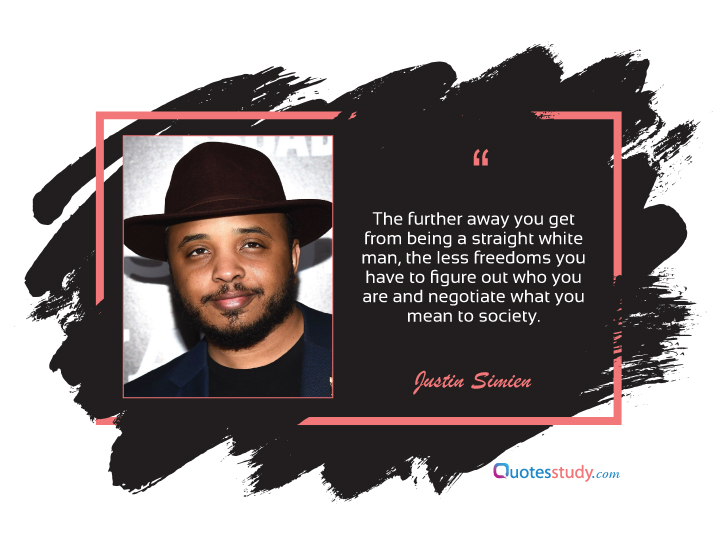
“The further away you get from being a straight white man, the less freedoms you have to figure out who you are and negotiate what you mean to society.”
― Justin Simien
“You know what, man, that’s part and parcel of being a black person in this country: everything’s harder. It just is.”
― Justin Simien
“Any time a black person has the audacity to tell everybody else that they’re also human beings, they are confronted with all kinds of malice and violence and ill will. It’s been that way since black people were brought to this country.”
― Justin Simien
“I think we all have identity crises throughout our lives.”
― Justin Simien
“For whatever reason, gay characters, or characters that deal with sexuality issues, who are black, in ‘black films’… are typically not dealt with with any sort of complexity. They’re exoticized: their being gay is sort of the point.”
― Justin Simien
“There are a plethora of ways of being black, just like there’s many ways to being white.”
― Justin Simien
“There is a difference between being offended and being prejudiced and even being bigoted against. There’s a difference between that and racism.”
― Justin Simien
“When you’re part of a society where you’re constantly having to define your identity and sort of negotiate with what the mainstream culture thinks you are, you have less energy and time to figure out who you are when you go home at night.”
― Justin Simien
“We get caught in our little silos and end up working against ourselves. And I think social media culture really encourages that, because you’re really just shouting into a void hoping someone picks up on what you’re saying.”
― Justin Simien
“We like to think of the ’60s as Martin Luther King, Jr. and Malcolm X and a little bit of friction – no, there were all of these different groups. There was the Student Nonviolent Coordinating Committee (SNCC), the Black Panthers, Martin and Malcolm, but also the Whitney Youngs of the world, the Bayard Rustins of the world.”
― Justin Simien
“I wanted to be a filmmaker since I was a kid. I always did things that took me a little closer to that.”
― Justin Simien
“I took an internship at Focus Features while I was in film school. I was really interested in how specialty movies were marketed and found their audience despite being about topics that were outside of the mainstream.”
― Justin Simien
“I think I’ll always be making movies that intend to say something new.”
― Justin Simien
“If you examine any aspect of the human condition long enough, you really do have to start laughing at it. Because the business of being human is kind of ridiculous.”
― Justin Simien
“I think I have a threshold for taking things too seriously.”
― Justin Simien
“One of the most powerful lessons I learned is when you make an argument in a film, you have to make sure both characters are right.”
― Justin Simien
“Usually, with ‘Star Trek,’ you always trust the captain. The captains are always going to pull us through; the captain’s always going to win.”
― Justin Simien
“Racism is over in the ‘Star Trek’ future, but they found a way to comment on sexism and racism in the present day in such a subversive and smart way, you know?”
― Justin Simien
“I love great prestige television, but because I make television, sometimes I don’t want to, like, you know, fall into a very heavy cerebral drama.”
― Justin Simien
“I went to a school called Chapman University, which is a wonderful film school. It was a great program, but it was very white, and it was a culture shock for me because I grew up in Houston, Texas, and I went through what they call magnet schools, so my friends were like a Benetton ad.”
― Justin Simien
“If I just wanted to put clean, perfect images of black people on the screen for an hour and a half, first of all, there are other people already doing that, and they’re making a lot of money doing it.”
― Justin Simien
“I definitely have fun commenting on the real world and interpreting through the ‘Dear White People’ lens.”
― Justin Simien
“America is a different country, and it will forever be a different country after the election of Donald Trump.”
― Justin Simien
“My thing is to try to tell the truth as honestly as possible. For me, the weight is, how can I tell the truth through fiction, the best that I can?”
― Justin Simien
“I tend to take on too many projects at the same time, but as I’ve always done, I will continue to shift my focus onto whatever feels most urgent in the moment.”
― Justin Simien
“Every movie has the thing it’s about, and then, deep down, it has this thing that it’s really about. ‘Star Wars’ is not really about a space opera, action, and the galactic quest. It’s about self-doubt.”
― Justin Simien
“Hollywood is a world where the only thing that gets green-lit is something that made money the last year.”
― Justin Simien
“There was a time when a studio executive would really love something and have no proof at all that it would work and just do it because they believed in it. That’s how ‘Star Wars’ happened.”
― Justin Simien
“It is a fine line between making fun of the right thing and making fun of the wrong thing. And the language oftentimes is the same.”
― Justin Simien
“I know it’s ‘Dear White People,’ and you can imprint all kinds of concessions about what the show might be about on the title, but my goal was never to, like, educate white people. My goal was always to create characters that you can relate to and fall in love with.”
― Justin Simien
“Here’s the thing: I come from a filmmaking background, so this concept of sort of overseeing a television show but not directing was, in general, not weird, but I had to get used to what that felt like. My initial instinct was, ‘I want to direct as much of this as possible.’ But the logistics of making of TV, that’s just not possible.”
― Justin Simien
“Part of my struggle with being gay was that a lot of my homophobia was internalized because of the cues that I was – received. I didn’t see anybody like myself in the culture. RuPaul was the closest to a gay, out black man that I had growing up.”
― Justin Simien
“It’s always kind of gratifying to go back to the place that launched you and show you did good.”
― Justin Simien
“Films with predominantly white casts can come in any form, tell any story, big or small. For black films, you have the light, fluffy rom-coms or ‘Madea’ movies, and then you have the black-torture awards movie.”
― Justin Simien
Leave a Reply